Meta's New Location Fees (July 2026): A Direct Hit to Your Unit Economics
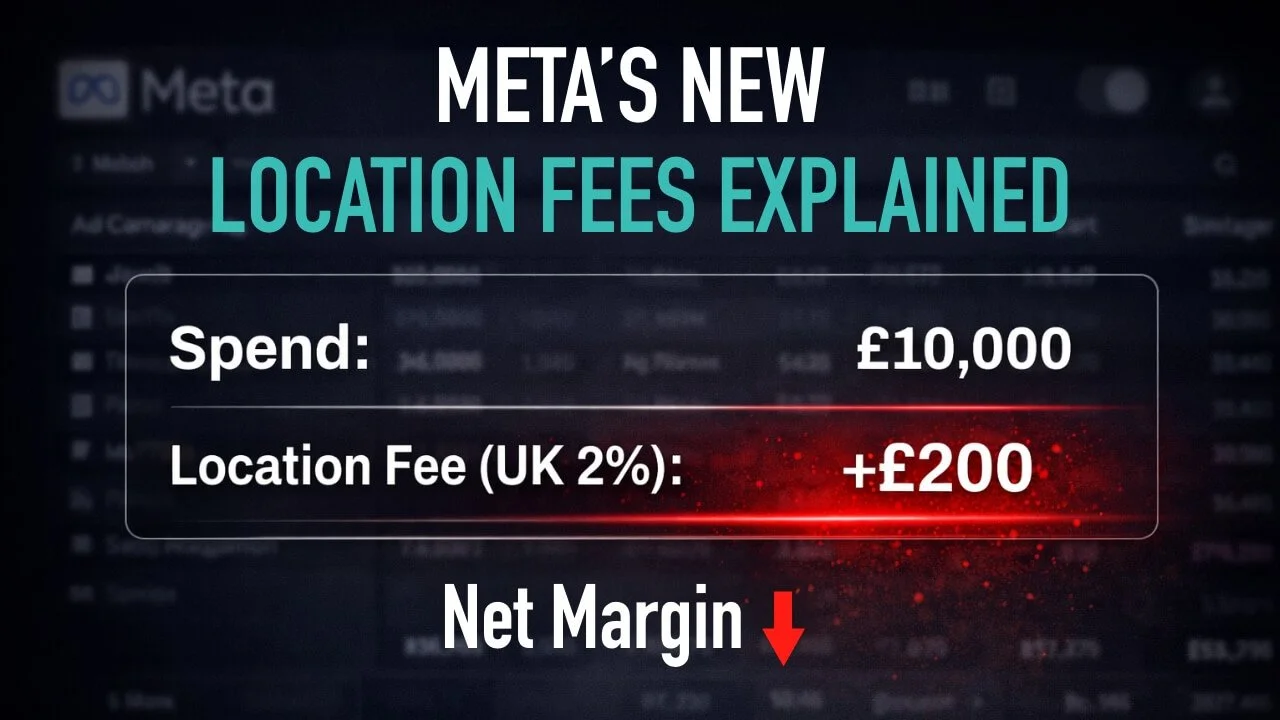
Meta’s Location Fees: Why Your Reporting Needs the Full Advertising Cost
Since 1 July 2026, Meta has applied location fees to advertising delivered in selected jurisdictions, passing on costs associated with Digital Services Taxes and other regulatory charges. The applicable fee depends on where the advertising is delivered.
These charges affect the cost of acquisition. Even a modest surcharge changes the economics of a campaign when budgets scale or margins are tight.
The reporting distinction matters: location fees appear in invoices and billing records but are excluded from Ads Manager reporting metrics. Platform ROAS therefore does not account for this additional advertising cost. Your commercial reporting needs to reconcile campaign spend with the applicable charges when assessing acquisition efficiency and contribution margin after advertising.
In my Meta Ads management and consultancy, I assess campaign performance against agreed acquisition targets and available commercial data. Accounting for applicable fees helps establish a more accurate cost base for budget planning and optimisation.
The Raw Data: What Are Meta's New Location Fees?
Let us strip away the corporate PR regarding an "evolving regulatory landscape." The commercial reality is simple: European governments are levying Digital Services Taxes (DST) on major tech platforms, and Meta is passing that cost directly onto your P&L.
Crucially, these new location fees are dictated entirely by where your ads are delivered (the impressions), not where your business entity is registered. You could be a US-based or UK-based brand, but if you are scaling aggressively into Austria or Türkiye, your ad spend in those specific regions will be subjected to a 5% surcharge. It is a granular, impression-level tax that ignores your operational headquarters.
The Breakdown by Jurisdiction
With the 1 July 2026 deadline rapidly approaching, here are the current surcharges that will be applied to your ad spend based on your audience's location (as outlined in Meta’s official business help centre):
Applicable Location Fees
Current regulatory surcharges applied to ad delivery across key European and surrounding regions.
Meta has explicitly noted that these jurisdictions and rates may change over time. From a commercial architecture standpoint, it is highly probable that this list will expand as more countries formalise their digital taxation policies.
The Invoice Disconnect: How This Secretly Inflates Your ncCAC
The most dangerous aspect of this update is not the existence of the fee itself, but the mechanics of how Meta intends to charge it.
If you set a daily campaign budget of £1,000, Meta will not reduce your ad delivery to accommodate the location fee. Instead, they will deliver your full £1,000 worth of impressions and then tack the location fee onto your final invoice as a separate line item.
To see how this quietly inflates your unit economics, let us look at the exact mathematical flow of a transaction:
The Compounding Cost of Location Fees
Base Ad Delivery
Impressions delivered to users within Italy.
Italy Location Fee (3%)
Regulatory operating cost added by the platform.
The Taxable Base
The fee is now integrated into the media cost.
This creates a severe disconnect between what your media buyers think they are spending and what your finance team is actually paying.
When your invoice arrives, it will be itemised by jurisdiction (e.g., "Italy digital services"). Because these fees are added post-delivery, your true Cost Per Acquisition (CPA) is instantly higher than what you planned for. If your financial models operate on tight margins, this unbudgeted inflation of your ncCAC (new customer Customer Acquisition Cost) will quietly, but aggressively, eat into your Contribution Margin.
Why This Breaks Standard ROAS Reporting
We return to the fundamental flaw of the standard agency model: optimising for in-platform vanity metrics. With the introduction of these location fees, the Meta Ads Manager dashboard is no longer just biased; it is mathematically incomplete.
When your media buyer—or your automated scaling rules—evaluates a campaign, they are looking at a ROAS figure calculated before location fees and VAT are applied. The platform's algorithm is entirely blind to your final invoice.
Imagine a campaign targeting the UK and France that is hovering right on your break-even ROAS target. The dashboard will tell you to maintain or even scale your spend because it looks perfectly efficient in a silo. However, once the 2% and 3% location fees are tacked onto the back end, that campaign immediately slips into negative cash flow.
If you are making capital allocation decisions based on in-platform ROAS, you are now operating with fundamentally flawed data. You are underestimating your true Cost Per Acquisition (CPA) and acquiring customers at a higher ncCAC than you realise. This is exactly how scaling a seemingly "profitable" campaign on Meta can quietly drain your business's net profit.
Action Plan: Updating Your Commercial Data Engine
The solution is not to panic, nor is it to blindly pause campaigns in European markets. As a Creative Systems Architect, my approach is to engineer a system that automatically accounts for these variables. If you are a founder or C-suite executive, here is your strict action plan to protect your unit economics ahead of the 1 July 2026 rollout:
1. Update Your Financial Forecasting: Do not wait for your first inflated invoice to arrive in August. Pull your historical impression delivery data by country for the last 12 months. Calculate your blended location fee based on your specific geographic revenue split. You must update your P&L projections immediately to account for this new, unavoidable variable cost.
2. Adjust Your Reporting Architecture: Standard API pulls from the Meta Ads Manager will only give you base media spend. If you are using a bespoke reporting framework, your data engineers must update the architecture. You need to either ingest actual billing and invoice data directly or build custom calculated metrics that dynamically apply the correct jurisdiction multipliers (e.g., spend * 1.02 for the UK) to your daily spend before calculating your daily net profit.
3. Recalculate Your Baseline MER and ncCAC Thresholds: Because the cost of delivering ads is increasing, your baseline Marketing Efficiency Ratio (MER) must shift to absorb these new fees. If you maintain your old MER targets and ncCAC thresholds, your Contribution Margin will silently shrink. You must recalculate the absolute minimum efficiency required to cover your COGS, your standard variable costs, and these new location fees.
Ultimately, this update from Meta is a harsh reminder: platform algorithms are designed to spend your money, not manage your profit. By updating your commercial data engine now, you ensure that every pound spent—including taxes and location fees—is accounted for, protecting your bottom line from regulatory collateral damage.