The ROAS Trap: Why Contribution Margin is the Only Metric That Matters
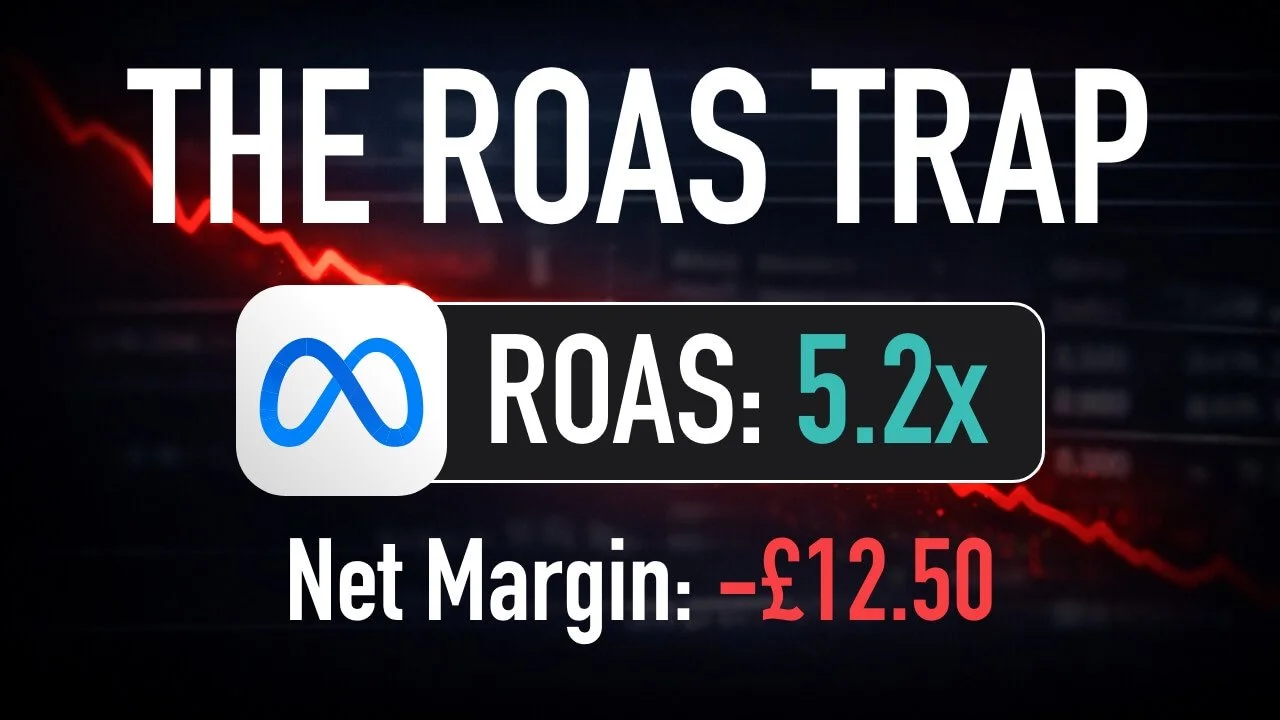
The Dashboard Illusion: Why In-Platform ROAS is a Vanity Metric
If you are a founder or C-suite executive in the e-commerce space, you have likely experienced this disconnect: you are reviewing a campaign report showing a strong 5x ROAS on Meta or TikTok, but when you look at your P&L, the net profit simply is not there.
This is the ROAS trap.
It is not a failing of the teams running the ads - it is a systemic issue with how digital acquisition is measured. Ad platforms are designed to optimise for and report on their own in-platform metrics. However, relying solely on ROAS creates a silo, divorcing your paid media performance from your actual commercial reality. ROAS does not pay your supply chain. It does not fund your operations. And it certainly does not account for the harsh realities of your unit economics.
As a freelance Meta Ads consultant, I connect campaign management and creative testing with commercial analysis. Whether I work directly with an e-commerce brand or alongside its agency, I assess acquisition performance against the costs and margins that determine what the business can afford to spend.
ROAS remains useful for understanding platform-attributed revenue relative to advertising spend. Assessing profitability also requires product costs, fulfilment, returns and other variable costs. Contribution margin after advertising helps establish what remains to cover fixed costs and profit, giving budget decisions a stronger commercial foundation.
The Unit Economics Reality Check: 4x ROAS vs. 2x ROAS
When we evaluate performance media purely on ROAS, we ignore the most critical variables in e-commerce: Cost of Goods Sold (COGS) and variable costs (pick, pack, dispatch, and payment gateway fees).
ROAS treats all revenue as equal. Your P&L does not. To see how dangerous this disconnect is, let’s look at the underlying maths of two different products, both with an Average Order Value (AOV) of £100.
Scenario A
Scenario B
If you are only looking at your Meta or TikTok dashboards, Scenario A looks like the clear winner. The algorithm is happy, the ad accounts look incredibly efficient, and the natural instinct is to pour budget into scaling it. Meanwhile, Scenario B looks average at best, and many media buyers would be tempted to pause those ads.
However, the commercial reality is the exact opposite. Scenario B delivers six times more actual cash profit to your bottom line per transaction.
This is why Contribution Margin is the only metric that matters. It strips away the illusion of gross revenue and reveals the true financial health of your acquisition engine. If you scale your spend based on ROAS alone without a rigorous understanding of your unit economics, you risk aggressively scaling unprofitable revenue. You are buying top-line growth at the expense of your own cash flow.
Shifting the Paradigm: Introducing the Marketing Efficiency Ratio (MER)
When you accept that platform attribution is inherently biased, you need a new commercial north star. This is where the Marketing Efficiency Ratio (MER) becomes invaluable.
MER is wonderfully simple, yet highly effective. Unlike in-platform ROAS, which relies on an algorithm claiming credit for a conversion—often leading to double-counting across Meta, TikTok, and Google—MER provides a holistic, top-down view of your entire marketing ecosystem.
The MER Formula: Your Commercial North Star
Total Business Revenue
All gross sales across your entire e-commerce store (Shopify/Magento), regardless of the traffic source.
Total Ad Spend
The blended, combined spend across every paid acquisition channel (Meta, TikTok, Google, etc.).
MER is your financial anchor. It does not care which ad recorded the last click; it only cares about the ratio of cash leaving the business to cash entering it.
Understanding the formula is one thing; applying it to your P&L is another. Let's look at a real-world commercial scenario:
Commercial Scenario: MER in Practice
Let’s put the theory into practice with a clean set of monthly numbers:
The Commercial Reality: > This means your business is operating at a blended 5x return on its marketing capital. It completely bypasses the attribution war between the platforms. You do not need to argue over whether Meta or TikTok deserves the credit for a specific sale. The metric simply states the commercial truth: for every £1 leaving the business to acquire customers, £5 is returning to the top line.
Aligning MER, Contribution Margin, and ncCAC
Understanding your MER is just the foundation. To build a truly predictable acquisition engine, you must inextricably link your MER to your Contribution Margin and your ncCAC (new customer Customer Acquisition Cost).
Here is how this ecosystem functions in practice:
The Baseline: Your baseline MER is the absolute minimum efficiency required across all marketing spend to cover your COGS, your variable costs, and still protect your target Contribution Margin.
The Threshold: Once this baseline is established, it dictates your strict thresholds for ncCAC. This is the critical transition from standard media buying to performance architecture. By knowing exactly how much you can afford to pay to acquire a new customer without dipping into negative cash flow, you remove the emotion from scaling.
The Green Light: If your blended MER remains above your baseline and your ncCAC stays within its designated threshold, you have the commercial green light to scale your Meta and TikTok campaigns—even if the daily ROAS in the dashboard fluctuates.
You are no longer reacting to platform volatility; you are trading on established unit economics.
How to Stop Flying Blind: Building a Commercial Data Engine
Understanding your unit economics is only half the battle; the other half is operationalising that data. If you are still relying on out-of-the-box platform reports or standard Shopify analytics, you are flying blind. To execute a strategy based on Contribution Margin and MER, you must build a robust commercial data engine.
This requires a shift from reactive media buying to proactive technical architecture. The foundation of this engine is clean, reliable data collection. With ongoing browser-level restrictions and the continual degradation of third-party cookies, relying solely on client-side pixels is a massive technical debt. Implementing robust server-side tracking—specifically the Meta Conversions API (CAPI) and TikTok Events API—is strictly non-negotiable for high-growth brands.
The Commercial Data Engine: System Architecture
The Inputs (Traffic & Spend)
Meta, TikTok, and Google push raw Ad Spend data into your central reporting framework.
The Conversion (First-Party Data)
A customer purchases on your Shopify/e-commerce storefront, creating a first-party data event.
The Server-Side Feedback Loop (CAPI)
Purchase data is sent directly from your server back to the ad platforms, bypassing browser restrictions to train the algorithms on high-intent buyers.
The Commercial Reality Check (Deductions)
The framework automatically subtracts costs from Gross Revenue to find the true bottom line.
The Output (The Truth)
You are left with a real-time, unfiltered view of your Contribution Margin and ncCAC.
Once this architecture is in place, the commercial benefits are immediate. Looking closely at the data collection phase (Step 3), passing first-party data directly from your server to the ad platforms drastically improves signal resilience and match rates. This feeds the algorithms with higher-quality data, allowing them to optimise for high-intent purchasers rather than easily attributable window shoppers.
However, as outlined in Step 4, data collection is just the plumbing. The real value is unlocked in your reporting framework. A true commercial data engine pulls live spend from your acquisition channels, cross-references it with your central source of truth (your e-commerce backend), and automatically subtracts your variable costs.
Building this bespoke reporting setup provides the ultimate output (Step 5): a real-time, unfiltered view of your net profit. It allows you to make rapid, high-leverage decisions on capital allocation, confident that every pound spent is actually driving tangible commercial growth.
The Bottom Line for Founders
Scaling a predictable acquisition engine on Meta and TikTok is no longer about finding a silver-bullet creative or hacking an algorithm. It requires absolute commercial rigour.
When you strip away the dashboard screenshots and the platform-reported ROAS, you are left with the only equation that matters: how much cash are you investing to acquire a customer, and how much cash is actually left over after all your COGS and variable costs are paid?
If your growth strategy is built entirely on in-platform ROAS, you are operating with a fundamental blind spot. You risk aggressively scaling unprofitable revenue and mistaking top-line growth for a healthy, resilient business. The platforms will always encourage you to spend more, but it is your responsibility to build the architecture that ensures that spend translates into tangible bottom-line growth.
It is time to audit your metrics. Step away from the ad manager, map out your unit economics, calculate your true Contribution Margin, and establish your baseline MER. Only when you have a functioning commercial data engine can you build an acquisition system that drives genuine, sustainable net profit rather than empty vanity metrics.