ASDA Money Meta Ads Case Study: Scaling Acquisition Across Three Financial Products
A first-hand account of how I led the creative performance strategy for ASDA Money at THG Studios, using live Meta campaign data to improve messaging, creative execution and audience strategy across credit cards, breakdown cover and motorbike insurance.
- Creative performance strategy
- Structured testing
- Paid social analysis
- Cross-product acquisition strategy
Key Commercial Results
The challenge
ASDA Money promotes several financial products, each with a different audience, proposition and conversion journey. A message capable of generating credit-card applications would not necessarily work for breakdown cover or motorbike insurance.
The challenge was therefore not simply to produce more advertising creative. It was to establish a repeatable testing framework that could:
Turn individual product benefits into clear creative hypotheses
Compare messaging and visual approaches consistently
Connect creative performance with meaningful downstream actions
Use live results to guide subsequent briefs and campaign decisions
Generate useful learning across different financial product categories
The objective was to move away from reactive, one-off asset production and create a more structured relationship between campaign data and creative development.
My role in the project
I completed this work while serving as Director of Creative Performance at THG Studios, working alongside ASDA Money’s marketing stakeholders and the wider THG delivery team.
I led the creative performance strategy. My responsibilities included:
Translating commercial objectives into structured creative tests
Defining the messaging, visual and audience variables being compared
Reviewing Meta campaign data and downstream application results
Identifying meaningful performance patterns
Turning those findings into new creative recommendations
Helping establish a consistent approach across multiple products
This was a collaborative programme. Campaign delivery, stakeholder approval and wider account activity involved the broader ASDA Money and THG teams.
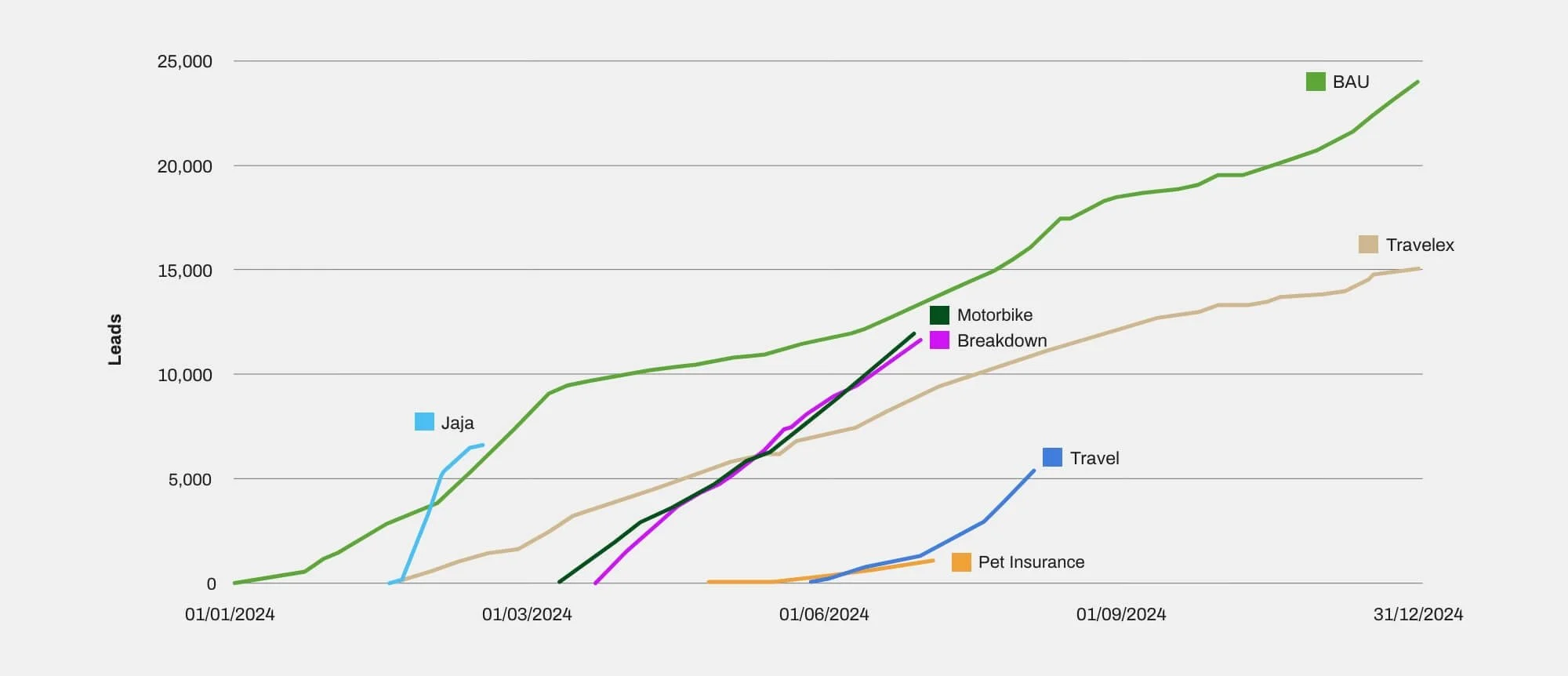
Cumulative platform-reported activity across separate 2024 campaigns. Product lines used different conversion events and campaign dates, so totals should not be compared directly.
How the Meta creative testing framework worked
Each product began with a different commercial objective, but the same underlying process was applied.
Define the meaningful outcome
The primary measurement depended on the product and its customer journey.
For credit cards, this included partner exits and submitted applications. For the insurance products, the reporting focused on tracked leads alongside supporting indicators such as CTR and CPL.
Build a clear hypothesis
Creative routes were developed around specific questions rather than subjective preferences. These included:
- Would trust-led messaging outperform offer-led messaging?
- Would product-first imagery outperform people-led creative?
- Which product benefit would produce the strongest response?
- Could a reduced-copy route improve acquisition efficiency?
- Which audience strategy could support greater scale?
Isolate the variables
Where possible, the tests separated changes in proposition, visual treatment, messaging and audience strategy. This made the results more useful when briefing the next round of creative.
Connect results with the next decision
The purpose of the reporting was not simply to rank ads. It was to identify what should be retained, what should be challenged and what should be tested next.
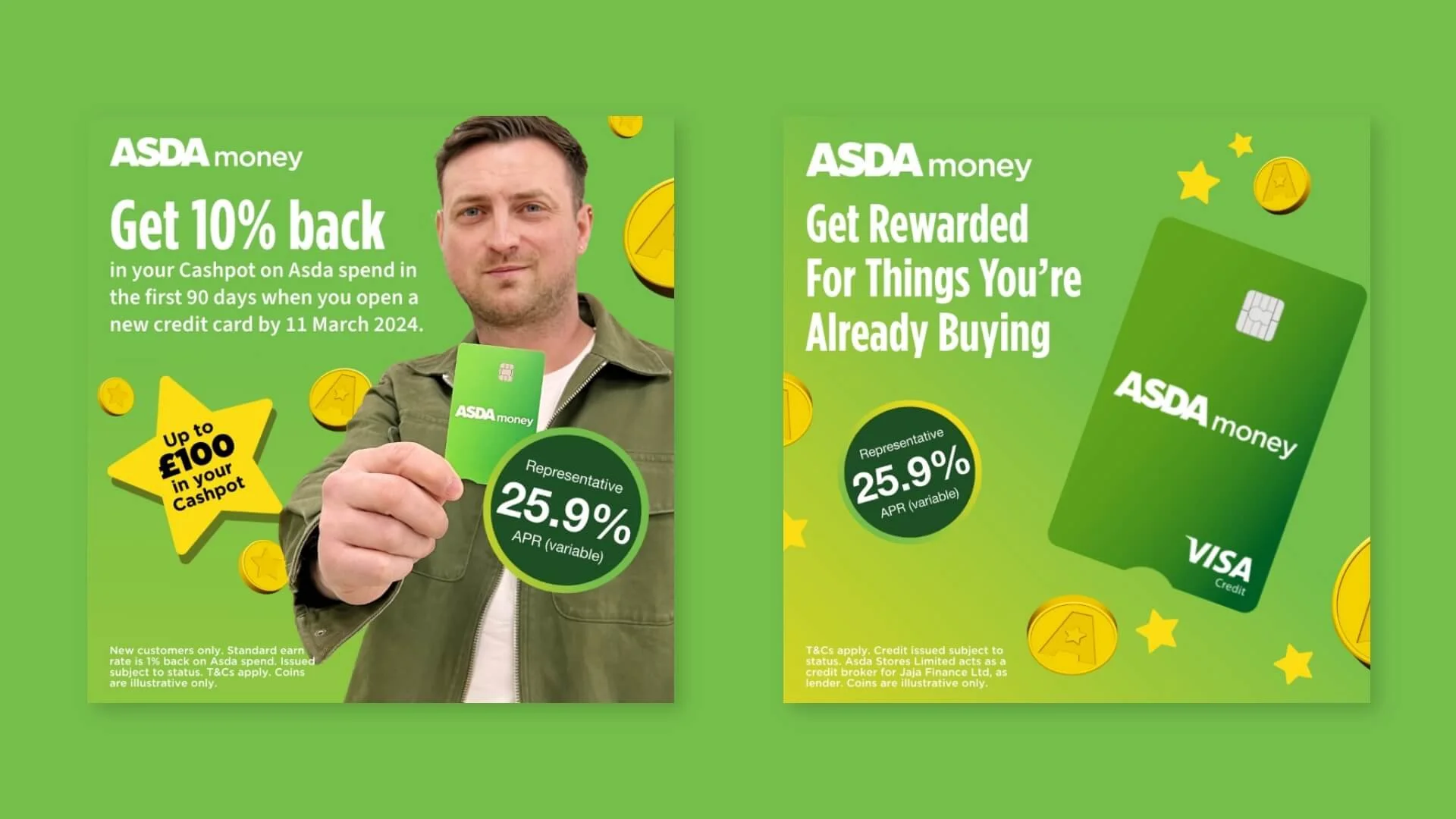
Historical campaign creative shown for context. Product terms, rates and promotional offers relate to the 2024 campaign and should not be treated as current promotions.
Credit cards: Improving application quality, not only traffic volume
The credit-card campaign provided the clearest evidence of how structured creative and audience testing could influence the full acquisition journey.
The testing compared:
Trust-led messaging against offer-led messaging
Card-focused imagery against people-led alternatives
Static and video executions
Retargeting audiences against a lead-based lookalike audience
The important distinction was that the analysis extended beyond clicks. Partner exits and submitted applications were used to understand whether the traffic was producing meaningful commercial action.
Commercial results
With spend finishing 3% below forecast, the campaign delivered:
45% more partner exits than forecast
275% more submitted applications than forecast
A 33% lower implied cost per partner exit
A 74% lower implied cost per submitted application
An exit-to-application rate of approximately 44%, compared with a forecast assumption of 17%
This indicates that the campaign generated more than additional traffic. The downstream application journey also performed substantially ahead of the planning assumptions recorded for the campaign.
Performance improved as the campaign developed
Between February and March:
- Partner exits increased by 99%
- Spend increased by only 8%
- Cost per partner exit fell by 46%
- The proportion of clicks progressing to the landing page increased by approximately 11 percentage points
Creative learning: Trust outperformed promotion
Trust-led creative produced:
- A 39% lower cost per partner exit than offer-led creative
- A 28% higher CTR
- A 15-percentage-point improvement in the proportion of clicks reaching the landing page
Creative learning: Show the product clearly
Card-focused assets generated approximately 83% of partner exits from 74% of the campaign spend.
Their cost per partner exit was 41% lower than the other visual approaches combined, which included people-led and cashier-based imagery.
Audience learning: Lookalikes supported efficient scale
The lead-based lookalike audience generated approximately:
- 79% of partner exits
- From 61% of campaign spend
- At a 57% lower cost per exit than the remaining audience pools combined
Breakdown cover: Direct benefits and specific proof points
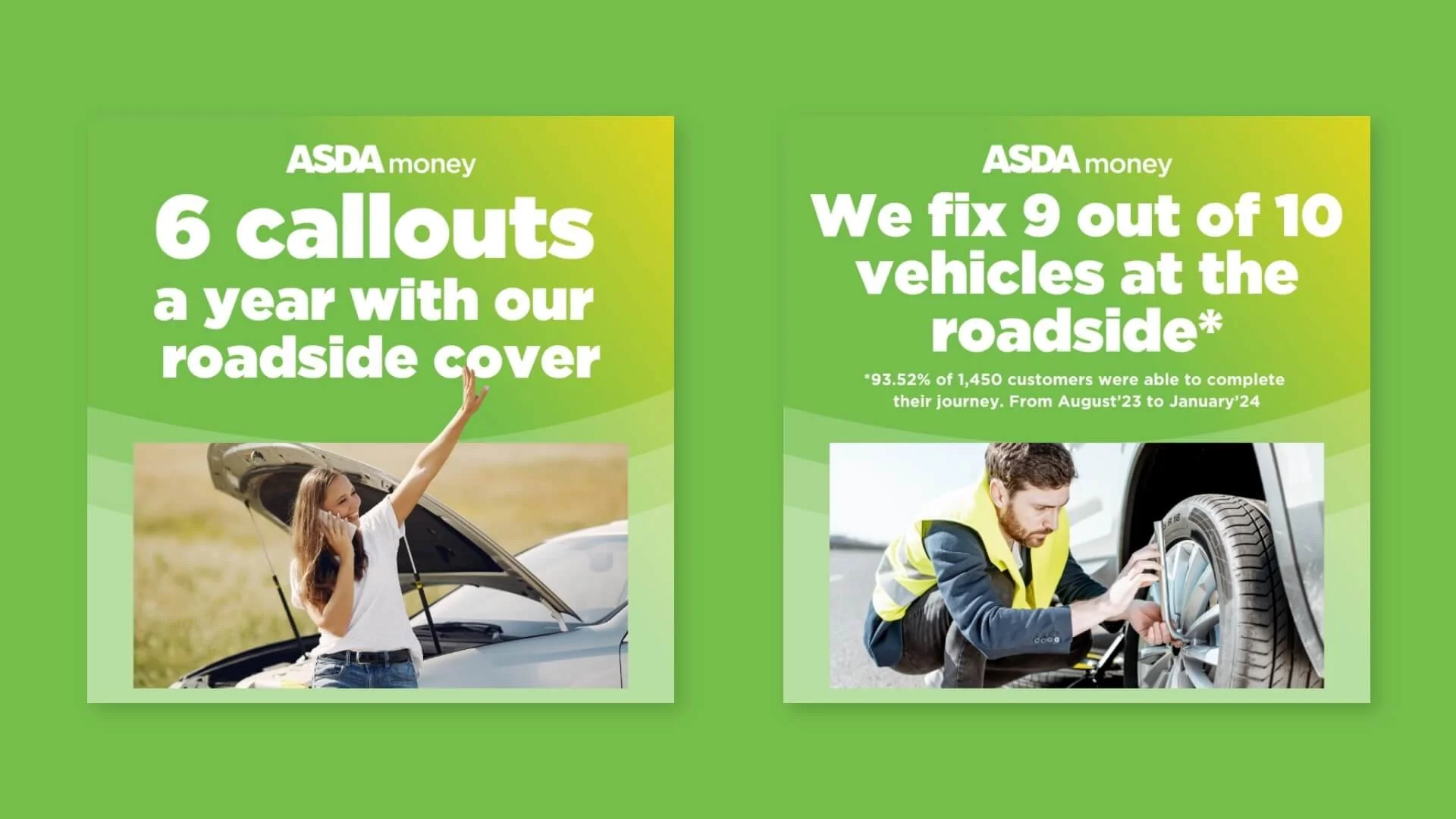
For breakdown cover, five creative propositions were compared:
Roadside cover
Six callouts per year
Nine out of ten vehicles fixed at the roadside
Count on us
Access to 4,000 professionals
The direct “Roadside Cover” route was the main source of scale, generating approximately 51% of the tracked leads from a similar proportion of spend.
However, the strongest efficiency signal came from the more specific “9/10 fixed at the roadside” proposition. Compared with the “six callouts per year” route, it achieved:
A 15% lower CPL
A 27% higher CTR
A stronger rate of progression from landing-page visit to tracked lead
The broader learning was that direct product communication could generate scale, while a clear and credible proof point could strengthen both attention and acquisition efficiency.
Generic reassurance messages received very little delivery, so the data was not sufficient to make a reliable judgement about those routes.
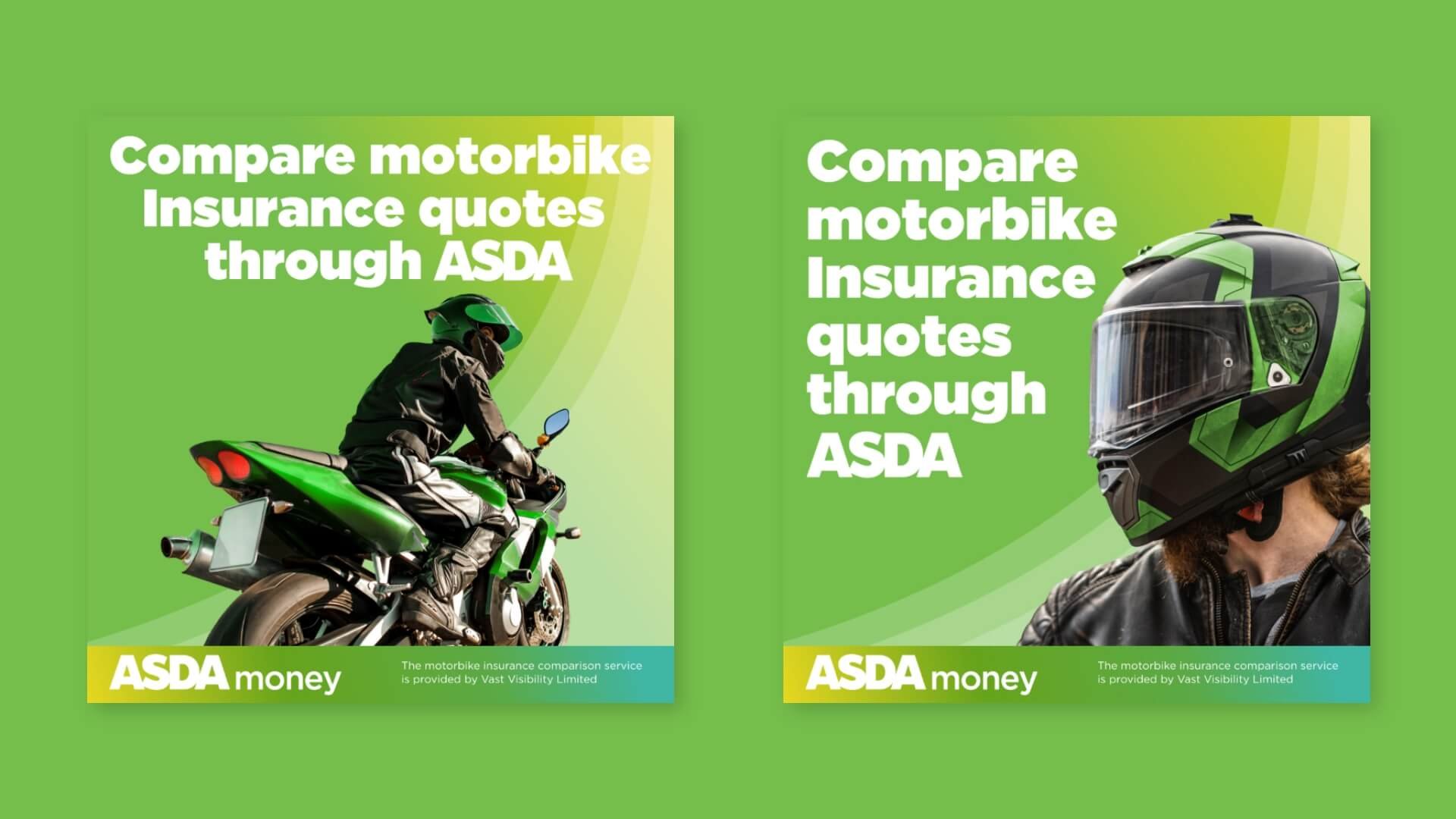
Motorbike insurance: Identifying the strongest route for scale
The motorbike insurance campaign tested several variations in messaging, imagery and copy length.
Two principal routes accounted for approximately 88% of tracked leads. The leading reduced-copy route generated:
22% more leads than the next-largest creative route
Using only 6% more spend
At a 13% lower CPL
With a 6% higher CTR
This made it the clearest route for continued investment and further iteration.
The result also reinforced an important creative principle: reducing copy does not mean reducing strategic clarity. A focused message, clear product context and easily understood proposition can make the creative faster to process without losing its commercial purpose.
What the programme demonstrated
The results showed that financial services creative should not be approached as one fixed visual system applied across every product.
Different categories produced different lessons:
Credit cards benefited from trust-led, product-focused creative and a strong lookalike audience
Breakdown cover responded to direct product communication and evidence-led proof points
Motorbike insurance benefited from a focused, reduced-copy creative route
The consistent element was the decision-making framework behind them.
By defining a hypothesis, measuring the appropriate commercial outcome and feeding the learning into the next creative brief, the team could make more informed decisions across a varied financial product portfolio.
The work also demonstrated why platform-level engagement metrics should not be assessed in isolation. The most useful credit-card insight only became visible when Meta performance was connected with partner exits and submitted applications further down the funnel.
Measurement and confidentiality
Results in this case study are based on Meta Ads Manager data and the downstream submitted-application totals recorded in the 2024 project reporting.
The credit-card activity covered February to March 2024. Breakdown cover and motorbike insurance results covered April to July 2024.
Forecast comparisons use the planning figures recorded in the project workbook. All percentages have been recalculated and rounded for clarity.
Raw budgets, audience details, account identifiers and commercially sensitive volumes have been withheld. Meta-reported results remain subject to the attribution settings used during the campaigns.
Performance reflects the combined influence of strategy, creative, audience selection, media delivery and the wider customer journey. These results represent this specific project and should not be interpreted as guaranteed outcomes for other advertisers.

About Me
I am a freelance Meta and TikTok advertising consultant with more than ten years of experience across paid social, creative strategy and performance marketing.
Before becoming an independent consultant, I worked as Director of Creative Performance at THG Studios, where I helped brands connect creative decisions with commercial performance across complex paid social accounts.
My work combines campaign strategy, structured creative testing and performance analysis to help businesses understand what is driving results and where they should focus next.
Need a clearer Meta creative testing strategy?
If your Meta account produces plenty of data but not enough actionable learning, I can help you build a more structured relationship between campaign performance, creative development and commercial decision-making.
My consultancy services cover Meta account strategy, creative testing, performance analysis and ongoing optimisation.