Myprotein Meta Ads Case Study: Balancing Brand and Performance
How a two-phase Meta creative testing strategy helped Myprotein understand when to use brand, value and promotional messaging across its customer acquisition campaigns.
- Brand vs. discount testing
- Creative strategy & methodology
- Performance analysis & reporting
Key Commercial Results
The business challenge
Promotional messaging plays a significant role in sports nutrition advertising. For Myprotein, conversion activity had traditionally been supported by prominent discounts designed to encourage an immediate response.
While this approach could generate short-term sales, it created a wider strategic question:
Could brand-led creative compete for new customers without relying exclusively on the strongest available discount?
The objective was not to remove promotional messaging completely. It was to understand how brand, value and discount propositions influenced acquisition performance, customer value and audience engagement at different stages of the funnel.
My role in the project
This project was completed while I was Director of Creative Performance at THG Studios, working in-house with Myprotein’s brand, creative and performance teams.
I led the creative performance strategy behind the test. My responsibilities included developing the testing framework, defining the creative hypotheses, shaping the propositions being compared and analysing how each approach influenced commercial and creative performance.
I then translated the results into practical recommendations that could inform future campaign planning and creative development. This approach to aligning creative testing directly with commercial outcomes forms the foundation of the framework I use today as a digital growth consultant.
The testing strategy
I delivered this project through two structured Meta creative tests.
To guarantee a clean commercial comparison, I created separate campaign cells for both the discount-led and brand-led creative. This framework allowed the product, campaign objective, and audience context to remain as consistent as practical whilst the core messaging changed.
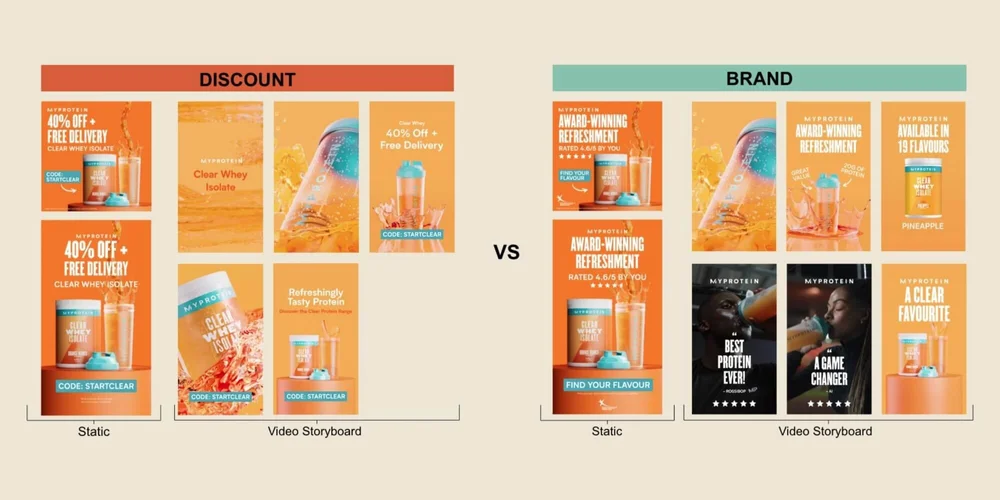
Brand versus a strong discount
The first test compared two distinct approaches.
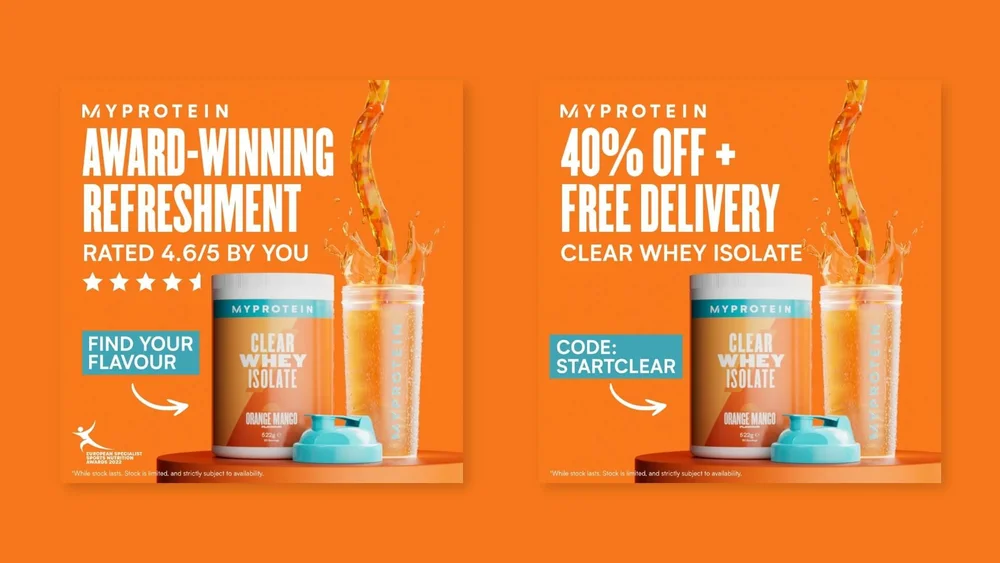
The discount creative focused on:
- A 40% promotional offer
- Free delivery
- Immediate savings
- Direct response messaging
The brand creative focused on:
- Product differentiation
- Taste and refreshment
- Customer ratings and social proof
- Product quality
- Brand recognition
This initial test was designed to establish the relative strengths of price-led and brand-led communication across acquisition and lower-funnel activity.
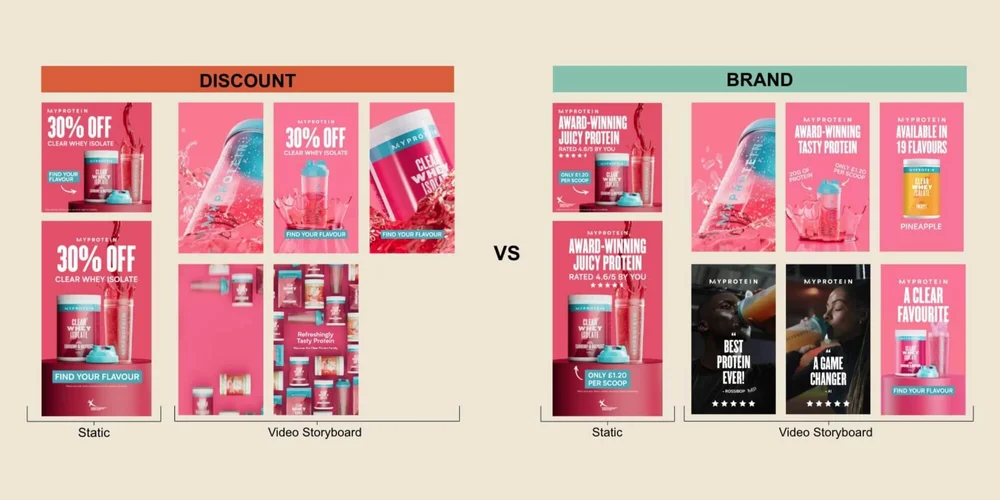
Brand plus value versus a reduced discount
The second test used the initial findings to refine both propositions.
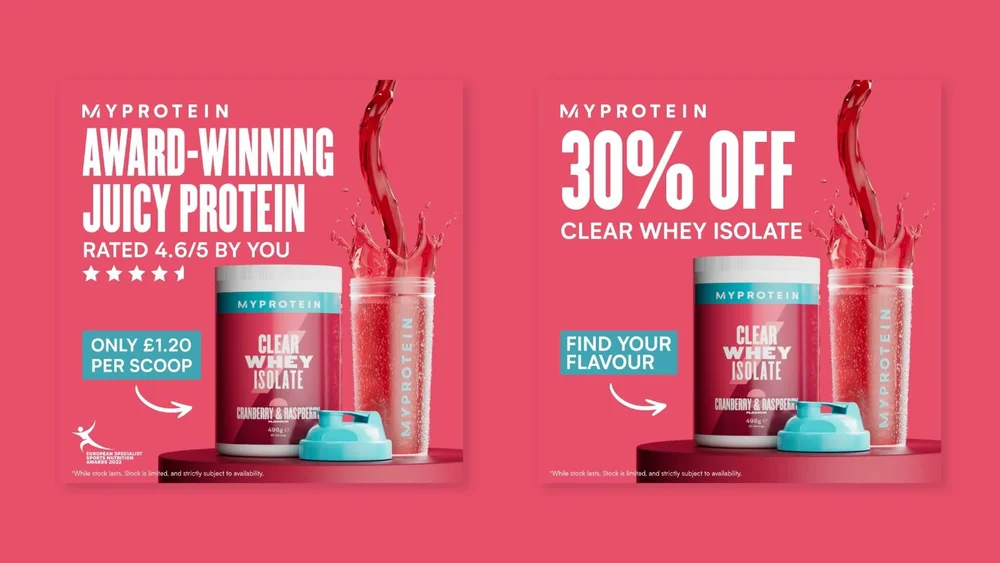
The promotional offer was reduced from 40% to 30%. At the same time, the brand creative was strengthened with a clear commercial value message, including the cost per serving.
The creative approach
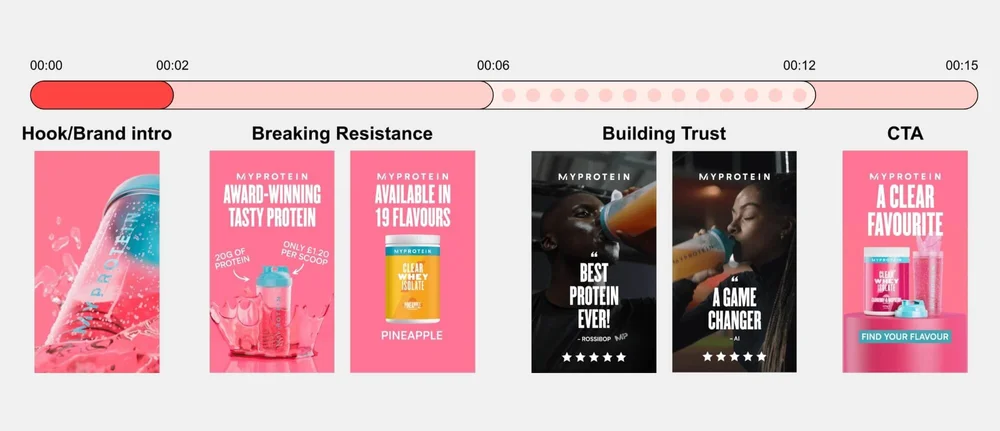
The brand video was structured around a 15-second performance framework designed to move from attention to action.
Hook and brand introduction
The opening frames established the product and brand immediately, using movement and distinctive product imagery to capture attention.
Product differentiation
The next stage communicated the main product benefits and helped explain how Clear Whey differed from more traditional protein products.
Building trust
Customer ratings, social proof and endorsement-led messaging were introduced to reinforce credibility and reduce purchase hesitation.
Call to action
The final frames presented a clear product or offer-led action, giving the viewer an obvious next step.
For Test 2, the opening proposition was made more direct and a specific value message was added. This allowed the creative to communicate both the strength of the product and its commercial value.
Test 1: Discount drove conversion while brand earned attention
The first test showed that the strongest promotional offer remained highly effective at generating an immediate response.
Price-led static creative was the strongest overall driver of last-click revenue and customer acquisition. This demonstrated that direct promotional messaging still had a clear role, particularly among audiences already familiar with the product.
However, the video-specific results revealed a different pattern.
Within the video comparison, the brand-led edit generated 264% more Meta-attributed revenue than the price-led video. It also reached a substantially larger audience and retained considerably more viewers throughout the video.
Brand creative also produced a higher AOV across the wider test.
The first test did not establish brand as the overall winner. Instead, it revealed that the two approaches performed different roles:
Discount creative was effective at converting existing demand.
Brand video was more effective at capturing and retaining attention.
Brand messaging appeared particularly valuable when introducing the product to new audiences.
Higher order values suggested that brand-led customers could have greater immediate commercial value.
These signals provided the basis for a second, more balanced test.
Test 2: Brand and value closed the commercial gap
Reducing the promotional offer and strengthening the value proposition produced a considerably more balanced result.
The discount treatment retained a marginal advantage in attributed revenue, finishing less than 3% ahead of the brand-plus-value approach.
However, brand-plus-value creative delivered several important advantages:
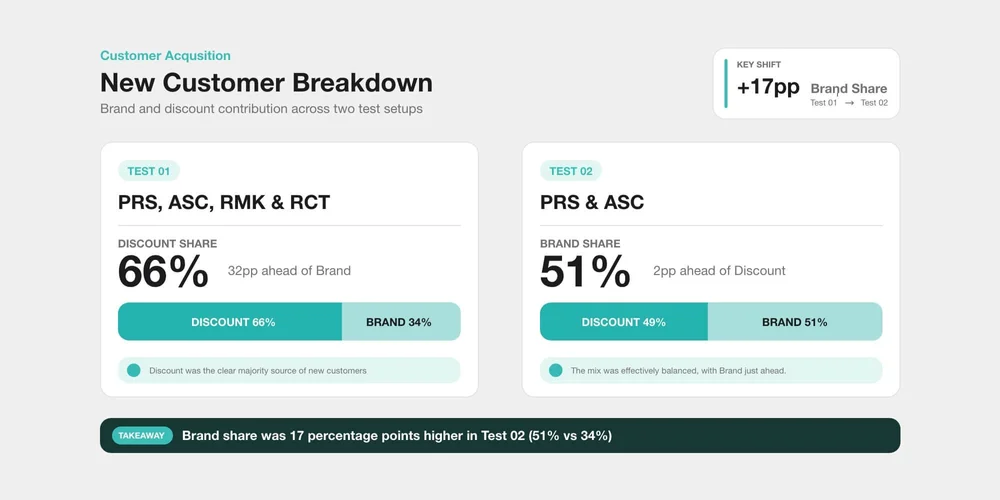
It generated a slight majority of the new customers acquired during the test.
AOV was nearly 5% higher than the discount treatment.
Reported CVR was more than 6% higher.
Three-second video plays were approximately 91% higher.
Near-complete video views were approximately 33% higher.
This demonstrated that brand-led creative could become commercially competitive when product differentiation was supported by a clear and relevant value message.
The result was not that promotional messaging had become unnecessary. It was that Myprotein did not need to rely exclusively on the deepest available discount to attract new customers.
Wider commercial impact
The complete redesigned creative system was also assessed against Myprotein’s existing BAU activity.
This broader creative system included both brand-led and promotional assets. It was therefore separate from the individual brand-versus-discount comparisons.
Compared with BAU, the redesigned approach recorded:
29% lower CAC
Approximately 54% lower COS
32% higher CTR
An 8% improvement in AOV
Greater reach, traffic and conversion volume
These results demonstrated the value of using a structured creative system rather than relying on one message or format across every audience.
The strongest outcome came from understanding the role each type of creative played and deploying it within the appropriate funnel context.
What the test changed
The project changed the strategic question from:
“Should we use brand or performance creative?”
To:
“What balance of brand, value and promotion does this audience need?”
New audiences were more receptive to creative that explained why the product was different, established credibility and provided reasons to buy beyond the promotional offer.
Warmer audiences required less persuasion and continued to respond effectively to direct, price-led creative.
This led to a clearer set of creative principles:
Use brand-led video to introduce products and build consideration.
Combine product differentiation with tangible value.
Retain direct promotional creative where audience intent is already high.
Measure creative against CAC, COS, AOV and customer acquisition, not engagement alone.
Use video engagement as a diagnostic signal rather than the final definition of success.
Adapt the proposition to the customer journey instead of expecting one asset to perform every role.
The strategic takeaway
The testing did not prove that discounting could be removed without affecting performance.
It demonstrated that brand-led creative could compete more effectively when supported by clear product differentiation, social proof and a meaningful value proposition.
At the strongest promotional level, discounting remained the dominant direct-response lever. When that promotional gap was reduced, the refined brand proposition closed most of the commercial difference, attracted a slightly larger share of new customers and generated a higher AOV.
The most valuable outcome was therefore not a single winning advertisement. It was a more informed framework for balancing immediate acquisition performance with stronger product and brand communication.
Measurement and confidentiality
Selected results are presented as relative changes to protect commercially sensitive business information. Raw campaign spend, revenue and order volumes have intentionally not been disclosed.
Figures are based on Meta Ads Manager reporting and represent platform-attributed performance.
This was a controlled live campaign comparison rather than a randomised incrementality or brand-lift study. The findings should therefore be interpreted within the context of the audiences, creative treatments and campaign conditions tested.

About Me
I am a marketing consultant and former Director of Creative Performance at THG Studios.
This case study documents work completed in-house for Myprotein before I became an independent consultant. Today, I help brands develop stronger Meta and TikTok advertising strategies, improve creative performance and turn paid media data into clearer commercial decisions.
Need a stronger Meta creative testing strategy?
I help brands build structured creative testing systems, identify what is driving performance and translate paid social data into practical commercial action. Explore my Meta Ads consulting service or contact me to discuss your advertising strategy.