
TikTok Shop GMV Max Case Study: Scaling a Multi-Brand Portfolio
I worked as a freelance marketing consultant, providing paid media leadership for an agency supporting a portfolio of TikTok Shop brands. My role combined campaign strategy, hands-on optimisation, creative analysis and custom Python reporting.
- GMV Max strategy & optimisation
- Creative analysis & testing
- Performance reporting & team guidance
Key Results
The challenge: Making better decisions as TikTok automated media buying
As the portfolio adopted GMV Max, more campaign decisions moved into TikTok’s automated systems. The agency needed a clear approach to product selection, creative supply, budgets and ROI targets, supported by reporting that showed what to change next.
The challenge varied by account. Some campaigns struggled to deploy their available budgets. Some relied heavily on a small number of products or creatives. Across large creative libraries, it was difficult to distinguish a repeatable pattern from a result based on limited delivery.
I focused on connecting campaign performance with practical decisions: which products warranted their own campaigns, which creative ideas deserved further testing, and where additional investment could be justified.
My role in the engagement
I led the strategic and analytical work across the portfolio. Operating as a specialist TikTok advertising consultant, I worked alongside the agency’s Paid Media Managers and Account Managers. Depending on the account, I either implemented changes directly or gave the delivery team recommendations to execute.
Developing GMV Max campaign structures and product-selection criteria.
Reviewing budgets, ROI targets and opportunities to scale.
Analysing creative performance and translating findings into briefs.
Building Python reporting and weighted creative-scoring tools.
Sharing account findings, training and optimisation guidance across the team.
This was a collaborative programme. Creators and brand teams produced the content, affiliate teams managed creator relationships, and LIVE teams delivered the broadcasts. Clients retained control of product economics and final commercial approvals; the agency retained overall client and operational ownership.
Assessing which products could support standalone campaigns
I reviewed recent product-level GMV alongside creative availability to identify products worth testing outside broader grouped campaigns. A strong seven-day sales history was a starting point, followed by a review of whether the product had enough usable content and an appropriate ROI target.
A dedicated campaign allowed its budget, ROI target and creative pool to be assessed separately. I applied this selectively: campaign separation was useful only if the product could sustain meaningful delivery.
Balancing scale with media efficiency
I reviewed spend, GMV, ROI and CPA together. A campaign with a high reported ROI could still be falling short of its commercial objective if it was deploying too little budget.
I used agreed targets and observed performance to recommend budget and ROI adjustments, then reviewed the result. This also required explaining the difference between shop-level performance, GMV Max reporting and conventional paid-ad attribution so that comparisons used an appropriate basis.
Turning creative analysis into better briefs
I built a weighted grading framework combining revenue and orders with CTR, CVR and video-retention signals. One historical analysis covered more than 2,000 TikTok ad records.
The score helped prioritise review. I then considered spend, runtime and sample size before recommending action. An exceptional return on very little spend was a reason to investigate further, rather than sufficient evidence for a large budget increase.
I examined the characteristics shared by stronger assets, including early product visibility, clear messaging and straightforward demonstrations of the benefit. These findings informed briefs testing different hooks, offers, proof points and visual approaches.
Building reporting the team could act on
I developed Python tools for account, campaign, product and creative analysis, alongside consistent weekly and monthly reporting structures.
The reporting connected three questions: what changed, what might explain the movement, and what should happen next. This gave managers a repeatable way to prioritise actions and share useful findings across accounts.
How I approached TikTok Shop growth
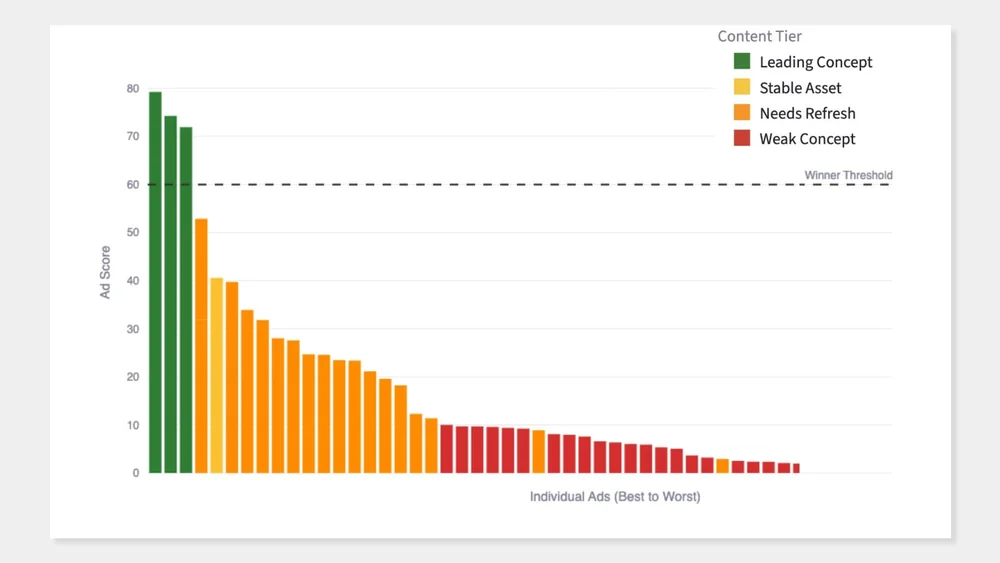
Illustrative example of the creative review framework. Scores help prioritise investigation alongside spend, runtime and sample size.
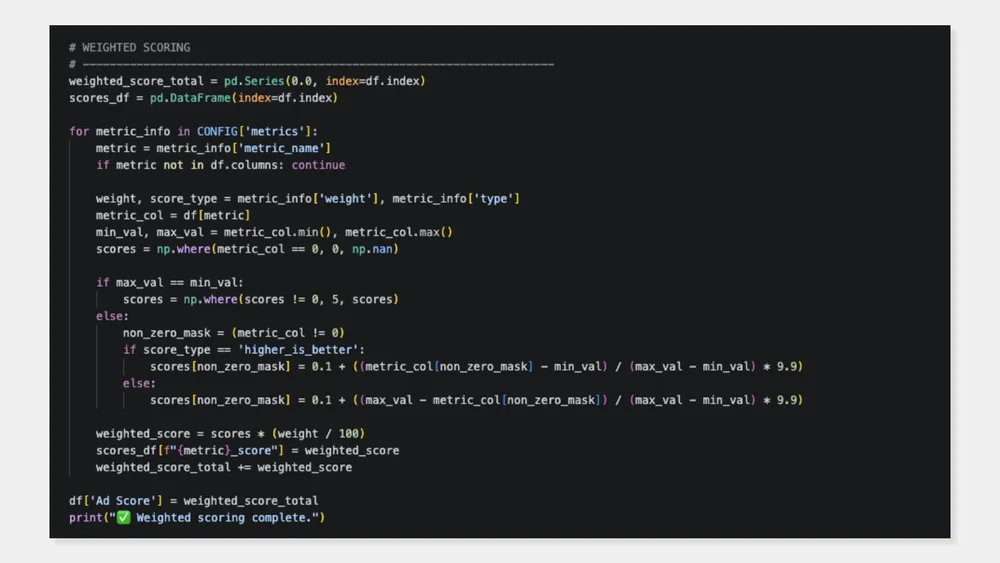
Extract from the Python workflow used to combine performance metrics into a weighted creative score. This shows one part of the analysis process.
Three decisions that shaped the work
Account A: Giving a proven product its own campaign
One product had established strong recent demand within a broader product group. I recommended testing it in a dedicated GMV Max campaign so its performance could be managed separately.
During 21-27 July 2025, compared with the previous week, the account reported:
- 46% more GMV on 39% more spend.
- Approximately 5.4% higher ROI.
- Approximately 7.5% lower CPA.
The account-level improvement supported further selective product testing. Budget increases and trading conditions also influenced performance, so the uplift cannot be assigned entirely to the structural change.
Account B: Adding paid support to LIVE shopping
I recommended ongoing LIVE GMV Max support to complement existing livestream activity, with a separate approach for larger events. The campaign launched on 8 August 2025.
During 11-17 August, compared with the previous week, the overall account reported:
- 215% more GMV on 165% more spend.
- 19% higher ROI.
- 17% lower CPA.
LIVE support became a substantial part of the account’s activity. Product campaigns also performed strongly, and the result reflected the combined contribution of media, content and wider trading activity.
Account C: Changing course when greater manual control underperformed
An August review explored whether Manual Select could improve creative selection within GMV Max. I compared its results with Auto Select across separate weekend periods at similar reported spend.
Auto Select recorded approximately 20% more revenue and 20% more orders than Manual Select. I moved the campaign back to Auto Select and revised the approach to testing specific influencer content.
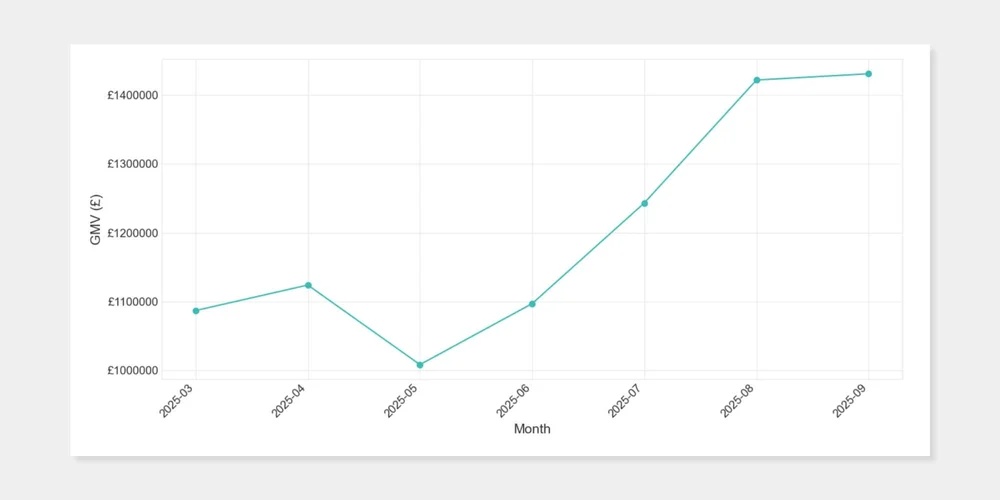
Figures reflect aggregated portfolio reporting. Growth compares September with March 2025 and may include changes in account mix. Affiliate GMV overlaps with other reporting categories. See measurement details below.
Portfolio performance during the reporting period
From March to September 2025, the available portfolio dataset recorded £8.41M in GMV. Monthly GMV increased from approximately £1.09M to £1.43M, a rise of 31.7%.
Over the same comparison, LIVE GMV increased by 108.5%, affiliate GMV by 42.2% and video GMV by 36.1%. Monthly items sold increased by 18.3%.
These figures establish the scale and direction of the reported portfolio. The individual account examples show more specifically how I used performance data to make campaign, creative and investment decisions.
What I introduced for the wider team
Alongside the account work, I introduced reusable tools and processes: creative scoring, product-selection criteria, standardised reporting, account-review guidance and a clearer route from analysis to the next creative brief.
Managers could use the same questions and review structures across accounts, while adapting the decisions to each client’s circumstances. I also shared successful tests and limitations so that learning from one account could inform the next.
My contribution combined direct optimisation with building the team’s capability to interpret performance and take informed action.
"It has been a pleasure working with Chris. Seeing how he operates on client calls, handles communication and approaches client work has been incredibly valuable. During a hectic few months, his calmness under pressure helped a tonne. I really appreciate the strategic work he put into the major accounts we shared. I’ve picked up a lot just by working alongside him."
Measurement and confidentiality
This case study draws on aggregated monthly portfolio reporting and account-level performance summaries from the engagement. I worked with the agency from March to October 2025; the portfolio figures shown cover March to September because October data was not included in the available export. Percentages are rounded.
GMV is presented as reported merchandise value, rather than audited net revenue or profit. Figures have not been independently reconciled to refunds, cancellations or accounting revenue. Portfolio GMV includes reporting across LIVE, video and product-card activity; affiliate GMV is an overlapping category and is not added to that total.
The account mix has not been verified as constant across the period. Portfolio changes are therefore presented as aggregate trends. Individual examples describe observed results, not isolated estimates of incremental sales caused by a single intervention.
The outcomes reflect the combined contribution of paid media, creative, affiliate activity, promotions and client operations. Agency, client, creator and account identities are withheld.

About Chris Curry
I am a freelance marketing consultant with more than ten years of experience across paid social, creative strategy and performance analysis. Previously Director of Creative Performance at THG Studios, I now help brands and agencies connect campaign decisions with clearer commercial reporting.
My work combines practical Meta and TikTok advertising expertise with custom analytics and structured creative testing.
Need a clearer strategy for TikTok Shop growth?
I work with brands and agencies that need senior support across GMV Max strategy, campaign optimisation, creative analysis and performance reporting.
Whether you need to assess an underperforming account or build a more consistent approach across a portfolio, I can help you identify the next decisions and put them into practice.